When was the iron age?

My new novel Tower of the Mountain King: The Wildness is set in a world based on a very early Iron Age Ireland. In the book, I use the traditional Irish name for the country: Eire.

It is an alternative world, where the priests of the Celtic tribes — the druids — use magic and practice divination. Spirits still linger in the ancient landscape, and the magical sidhe race dwell in deep forest enclaves; blessed with long life, cursed to always tell the truth, and linked to the magic of the land. The time period for the book is around 500 BCE – which is very early Iron Age in Ireland.

So when was the Iron Age? The dates vary, depending on the reference source, often quoted at anywhere between 1200 BCE and 600 BCE. Why the range of time periods? Because the Iron Age started at different times in different locations.

Technological changes in modern society can happen rapidly, where everything changes in a single generation, but they can also happen slowly, or “layer”, where the old technology survives in particular niches.

New technology can also be rare, and expensive, when it first appears.

It’s easy to forget that changes spread very slowly across society in prior time periods.

The Iron Age was thought to have started in the great early civilisations of the Near East, then soon after around the Mediterranean. The Greeks had iron and steel from around 1200 BCE, whereas the tribes in the area of modern Italy started working with iron perhaps three centuries later around 900 BCE (Rome founded in 753 BCE). In central Europe, which was at that time was filled with a whole series of independent Celtic tribes, the technology moved slowly west across the continent, only reaching the very western edge of Ireland somewhere around 500-600 BCE.

But just because the new iron technology arrived, it did not mean people stopped using the old one. Bronze blades and implements were used well into the common era.

The Trojan War — if it was indeed a single historical event — might have been fought between 1194 – 1184 BCE (dates give by the Greek Eratosthenes, once chief librarian at the Library of Alexandria), or even earlier. Iron technology might have been making its first appearance, but these guys would have been using bronze blades.

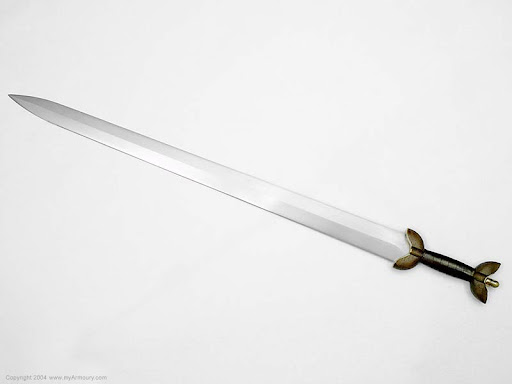
Bronze is one case of a layered technology that persisted for hundreds of years. Bronze swords were used across Europe from 1600 BCE to 600 CE. Generally shorter and less durable, they were prone to bending and losing their edge, but they were obviously a reasonable alternative.

In my world of ancient Eire, iron blades are prized, and used by the elite warriors and nobles, while the common clansmen, if called to war, were more likely to be equipped with spears with bronze blades and wooden shields, or with the typical short bronze swords or knives.

Whereas for armour, even my noble warriors are more likely to have the traditional bronze armour used, and passed on to them, by their ancestors, than the fancy new iron versions. Metal of any sort was prized, and expensive, for these rurally based tribes. The workers of metal — both bronze and iron — were privileged craftsmen, with a status equivalent to that of members of the noble, land-holding class. 

So, keen for some good old-fashioned fantasy action?

Check out Tower of the Mountain King: The Wildness, first book in the Ennistur Tales!

The western clans of Eire are under threat of conquest from  vast northern armies and the dark immortal Golsheth. Rejected from druid training, Prince Lathel is left with a hole in his mind, and his magical talent crippled. Cursed with the blood of magical sidhe race, he must embrace this unique legacy, journey into the heart of the Sidhe Realm, and claim the only power that can save the West.

Add one mind-controlling alien . . .

Every epic tale needs its villain. My new Fantasy book Warriors of the Blessed Realms is written against a backdrop of multiple worlds, and follows the adventures of heroes like Finn, from the Blessed Realms, and Liam, from Brisbane in Australia, as they fight the dark forces of the Vault of Seven Horns. They seek to defeat the plans of a cruel overlord, and rescue a captured priestess from a dark ritual that will give their enemy a vast increase in power. So who is the villain? Add one mind-controlling alien . . . the krell lord VoYannan!

So who are the krell? They are a solitary species that propagate without sexual union. Somewhere in their evolutionary history they took a dark, inward turn. In order to reproduce a krell must implant a krell-spawn into a host. The spawn grows in the host as a parasite until it rips its way free as a fully conscious krell. Nice eh? Heh – they are the bad guys! Each new krell possesses all the memories and talents of their progenitor, but their power as newborn krell depends on the choice of host. This is the fate of the captured priestess Sephany — unless our heroes can reach VoYannan’s ruined world and rescue Sephany from the depths of VoYannan’s dark citadel.

So why would a krell — who are always jealous of their power and control — loose a generation of krell-spawn on the universe? Because the sire and the newly born krell are mentally linked. The newly emerging krell can be leashed to their parent, and enhance the parent’s power. Yet there is a trade-off. As the new krell grows in strength, they can in turn consume and destroy their parent, as VoYannan did to his own progeninitor.

Krell don’t socialise well. In fact, they pretty much want to kill and dominate each other. Yet new krell keep coming.

The krell have awesome mind-control powers. Lord VoYannan, the ruler of the Vault of Seven Horns, controls fifty-eight planets, and dominates millions of sentient beings through direct mental control. He draws power from each, and enhances his power with each new mind brought under his control.

The Vaults themselves are dystopian SF worlds. Oppressed millions are kept in check by legions of laser-wielding brutes called Siithe, a savage race that consumes their victims (and even each other if they get the chance). Here are leaden skies, vast ruined cities, and factories manned by slaves from dozens of conquered species.

So, about the story . . .

Warriors is an epic tale spanning multiple worlds and multiple genres — fantasy, urban fantasy, and SF — where magic and high-technology go head-to-head.

VoYannan plots to unleash a devastating assault on the Blessed Realms, a coalition of six worlds with benign technology that is dedicated to preserving life. He uses an ancient Gateway on Earth to strike. His Vault forces capture the priestess Sephany, crucial to his plans, and escape.

Realm warrior Finn Evenstone sets off in pursuit, but cannot pass the Gateway used by the Vault.

Liam Durrow, sole survivor of an ancient Earth lineage, is led to Fraser Island by a vision, and uses his unique magical abilities as Keeper to open the Gateway.

Both Finn and Liam are soon battling the Vault on Earth, and in the Shadow Worlds, planets already ruined by the krell. They need all the help they can get. They are joined by tenacious Federal Agent Yolinda Paris, who has her own score to settle.

Check it out! Grab a copy of the book! Available at selected bookstores and these online retailers!

Avid Reader Bookstore

Amazon – Print and kindle

Barnes & Noble – Print and Nook

Google Books – Print

Booktopia – Print

Bookdepository – Print

Fishpond – Print

Waterstones – Print

Kobo – ebook

eBay – Print

itsi – epub

Warriors of the Blessed Realms Launches September 4 2020

The launch of Warriors of the Blessed Realms is finally here!

The online launch of the Warriors’ ebook will be on Facebook on Friday September 4 2020. Click on this link to join the online event!

There will be games and heaps of giveaways. I have prize packs of signed Jakirian Cycle books, and copies of the latest Lanedd Press edition of my SF book The Tau Ceti Diversion to give away, as well as rare editions of other collections with my stories inside to gift as prizes. The last Facebook launch, for the Lanedd Press edition of The Tau Ceti Diversion, was a great event, and I’m looking forward to sending Warriors’ off into the world in style.

Warriors’ is an epic tale, spanning multiple worlds and multiple genres — fantasy, urban fantasy, and SF. At its heart it is Heroic Fantasy, for which the works of David Gemmell gave me a life-long love.

The novel has both traditional fantasy settings as well as urban fantasy based in Brisbane and Sydney in Australia, as well as strong elements of both SF and horror. That’s quite a landscape, and a lot to balance, but readers can expected one Hell of a ride!

And the story . . .

The immortal krell lord VoYannan rules one of the Vault empires, dominating millions with the mind-powers of the solitary krell, drinking the souls of his thralls to fuel his talent. A prophecy foretells that he will leash the power of his Spawn if he can implant it in one special priestess — Sephany — and ensure it feeds on her broken spirit. 

In the Blessed Realms, Finn Evenstone, last surviving son of a once elite clan, waits for the attack. The talented Realm noble knows that the Vault will emerge through the Stonelake Gateway.

In Brisbane, Australia, Liam Durrow struggles to come to terms with strange visions. When his uncle and guardian dies in an accident, he learns he is the sole survivor of an ancient lineage. As Keeper he inherits unique magical abilities.

Using Earth as a stepping-stone, the forces of the Vault strike the Stonelake Temple and capture Sephany. A fierce battle ensues, but they escape with the priestess through the Gateway.

From Earth, Liam opens the Gateway for Finn, allowing him to continue the pursuit. They are joined by Federal Agent Yolinda Paris, who has her own score to settle with the Vault.

Their journey leads them through the Blessed Realms and other darker worlds ruined by the krell, until it reaches its climax in the court of krell lord VoYannan.

Want to read the story? Don’t forget to join the online event!

Great New Epic Fantasy

One the most exciting things to happen over the Christmas and New Year break was that I can across some great new epic fantasy. A new author discovery for me! Miles Cameron’s The Red Knight.

I could not say that Cameron is necessarily a new author. Cameron, who also writes under the pen name of Gorden Kent, has published a substantial body of historical fiction, as well as series of espionage thrillers, but he was certainly new to me as a fantasy author when I got hold of a copy of The Red Knight.

Every now and then an author comes along that makes you sit up and smile, and Cameron certainly did this for me with Red Knight. This is an exceptional novel. Well written, well plotted, with a unique magic system, a well-drawn world of epic fantasy, great action and excellent characterisation.

I was not so sure off the mark. Although obviously well written — Cameron writes like a pro and his background in historical fiction has given him clarity and precision — there were some things that put me off. These were in the realm of structure and artistic choices, rather than craft.

One was the high level of detail in armour description. I have a limited tolerance for technical descriptions that bog down the narrative flow, like extensive descriptions of sniper rifles in thrillers for example. Although I respected his obvious detailed knowledge of period armour, this was initially a negative for me.

The second thing was Cameron’s penchant for writing in vignettes. There was short scene after short scene — very short, some only a page or less — most of which introduced new character after new character.

Here Cameron had to work through the difficulty of the writer who draws a broad canvass for a series — how to introduce the necessary cast of characters without slowing down the story and confusing the reader. Well, for me it really did slow the story down, at least at the start.

By the time I was fifty pages in, I had accepted the detailed descriptions of armour as necessary for the piece. This was epic fantasy, with knights in armour and the whole panoply of attendant squires, men-at-arms, crossbowmen, archers etc, and the descriptions and specialised vocabulary ultimately added to the sharpness with which the world is drawn. My initial hesitation on this front was probably due to the fact that I am not typically an epic fantasy reader — I tend toward heroic fantasy in unique and completely non-medieval settings.

I was probably about one third of the way through the book by the time I had adapted to the continuing vignettes and was comfortable with the large array of characters.

By this stage I was completely hooked on the story.

If you love fantasy, and particularly if you like epic fantasy, check out The Red Knight.

I, for one, am really looking forward to the rest of this series. I haven’t been this excited by a new fantasy writer in a long time.


HERE BE SPOILERS! (If you want to read the book, stop reading now:)).

I love magic – hey that’s why I write fantasy – and I cannot remember the last time I enjoyed a new magic system as much. I really enjoyed the subsidiary characters, particularly the mage Harmodius.

The broader story, and the array of Wild creatures, was also very well done, with a mix of the new and familiar.

One thing I did think could have been stronger was the portrayal of Thorn. This man was supposed to have once been a magical genius, yet he reacted to like an angry adolescent to any provocation, and was ultimately revealed to have been manipulated by forces unknown. I would have liked more complexity in Thorn.

I do like my villains to be complex — something I probably got from reading so many Gemmell novels. Now there was an author who knew how to write shades of grey into both his protagonists, and antagonists.

Most Interesting Fantasy of the Year

I hope everyone had a great Christmas, and Santa brought you what you wanted.

Heading toward the end of the year, I thought I would reflect on the most interesting Fantasy of the Year. My overall favourite read would have to go to Ryhming Rings, the surprise posthumous publication by my all-time favourite writer David Gemmell, but here I’m talking about Fantasy novels particularly.

I did not quite know what to make of this book, since on the face of it, it featured many of the things that usually are deal-breakers for me, but I still come back to the novel as my most unusual Fantasy read of the year. The first novel by by Peter Newman, called The Vagrant.

The Vagrant was slightly offbeat, but overall a nicely worked piece.

The post-apocalyptic setting is well imagined, and it’s nice to see someone successfully pulling off a cross-genre mix of horror and SF, something I have a bit of a soft spot for.

The writing is good, but what had me gritting my teeth from the very outset was the use of present tense, somewhat of a pet hate of mine. And to make it even more of a challenge, the central protagonist is mute — yep, he doesn’t speak through the entire novel. Not only is the main character silent, but he is outside the point-of-view. The book is written in an omniscient viewpoint. I’ve got no particular problem with omniscient, but in that case I really look for the dialogue to express the inner world of the character. In this case that personality is successfully portrayed through the Vagrant’s heroic actions and his consistent integrity, which I enjoyed. I don’t typically go for anti-heroes, so that was a big plus for me.

The world is beautifully crafted, imaginative, and original. I was drawn through the story as much by the quest of the Vagrant to exit the cursed badlands where his journey begins, as by the vast amount of unknown backstory that is slowly drip-fed to the reader.

For me though, a reader who loves being hooked into character, the absence of the Vagrants PoV really hampered my ultimate enjoyment of the novel. Hey, but that’s just me.

Given the fact that the Vagrant has only his non-verbal interactions and his actions in response to challenges to demonstrate his character, Newman does of great job of creating sympathy. I think one of the core vehicles for this is the fact that the Vagrant is the guardian and primary carer for a tiny infant that spends most of the book hidden away in his coat (don’t worry that’s no spoiler! You learn that pretty much on page 1). Having him obviously caring and protecting an defenseless infant goes a long way to creating that sympathetic link between writer and reader.

Nice one Peter!